Table of Contents
- The Exercise-Prostate Research
- How Exercise Reduces Prostate Enlargement Risk
- Aerobic Exercise: The Baseline
- Resistance Training: An Underrated Tool
- Pelvic Floor Exercises for Men
- Activities to Approach with Caution
- How Much Exercise Is Enough?
- Getting Started If You Are Sedentary
- Combining Exercise with Targeted Supplementation
- Frequently Asked Questions
Of all the lifestyle factors studied in relation to prostate health, regular physical activity consistently emerges near the top of the list. The evidence is robust, the mechanisms are well understood, and the practical barriers to implementation are lower than for almost any other health intervention available to men. If you take one action today for your prostate health, make it moving more.
This is not a vague recommendation. The research is specific: the type of exercise matters, the amount matters, and consistency over time matters far more than occasional intensity. Here is what the evidence actually says — and how to put it into practice.
The Exercise-Prostate Research
A landmark Harvard Health Professionals Follow-Up Study tracking nearly 30,000 men found that those who engaged in vigorous aerobic exercise for at least three hours per week had a significantly lower risk of BPH-related urinary symptoms compared to sedentary men. The reduction in symptom severity was dose-dependent: more regular activity correlated with progressively better outcomes, up to a clear plateau.
A separate analysis from the same cohort found that walking briskly for two to three hours per week was sufficient to produce meaningful benefits for moderate urinary symptoms — without requiring high-intensity exercise. These findings have been replicated in European and Asian cohort studies with consistent results.
A 2015 meta-analysis published in a peer-reviewed urology journal confirmed that physical activity is inversely associated with BPH incidence and symptom progression: men who exercise regularly are less likely to develop significant BPH and, when they do, their symptoms tend to be milder and progress more slowly.
How Exercise Reduces Prostate Enlargement Risk
Multiple overlapping biological mechanisms explain why physical activity is so protective for the aging prostate:
Reduces Systemic Inflammation
Physical activity consistently lowers circulating inflammatory markers including interleukin-6 (IL-6), C-reactive protein (CRP), and tumor necrosis factor-alpha (TNF-alpha). Since chronic low-grade inflammation is a key driver of prostate cell proliferation in BPH, anything that reduces this inflammatory burden directly benefits prostate tissue health.
Improves Insulin Sensitivity
Exercise is one of the most potent natural reducers of fasting insulin levels and insulin-like growth factor-1 (IGF-1). Both insulin resistance and elevated IGF-1 have been associated with accelerated prostate cell growth. A single bout of aerobic exercise improves insulin sensitivity for up to 48 hours; regular training creates a sustained improvement in glucose metabolism.
Supports a Healthy Body Weight
Obesity is an independent risk factor for BPH progression. Excess adipose tissue produces estrogen through aromatization, worsens insulin resistance, and amplifies systemic inflammation. Exercise is the most effective tool for maintaining healthy body composition and, specifically, for reducing the visceral (abdominal) fat most closely linked to metabolic dysfunction and prostate enlargement.
Modulates the Sympathetic Nervous System
BPH symptoms are significantly worsened by high sympathetic nervous system tone — the “fight or flight” state that many men with sedentary, high-stress lifestyles maintain chronically. The smooth muscle of the prostate and bladder neck contains alpha-adrenergic receptors that contract in response to sympathetic stimulation, worsening urinary obstruction. Regular aerobic exercise reduces resting sympathetic tone over time, relaxing this smooth muscle and improving urinary flow.
Improves the Testosterone-to-Estrogen Ratio
Resistance training in particular supports healthy testosterone levels and, by reducing body fat, also reduces the aromatization of testosterone to estrogen. A more favorable testosterone-to-estrogen ratio creates a less permissive hormonal environment for prostate enlargement.
Aerobic Exercise: The Baseline
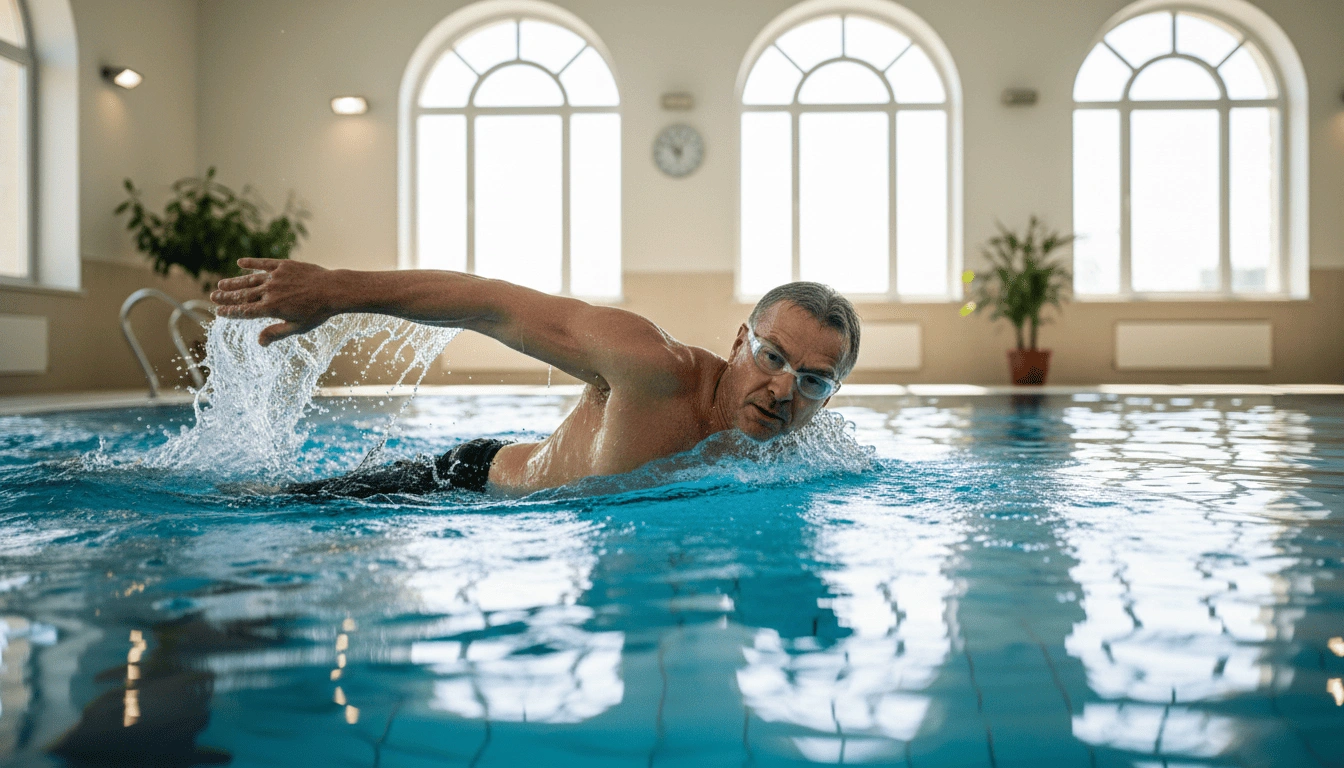
Brisk walking, cycling, swimming, jogging, rowing, and elliptical training all qualify as aerobic exercise with well-documented prostate health benefits. The evidence does not require high intensity to show effects: sustained moderate intensity (a pace where you can hold a conversation but are breathing noticeably harder than at rest) produces meaningful outcomes.
A practical aerobic target supported by the prostate health research: 30 minutes of brisk walking or equivalent activity on most days of the week. If time is limited, three 10-minute walks achieve similar metabolic effects to a single 30-minute session.
Consistency matters more than any single session. A man who walks 25 minutes every day will have done far more for his prostate over five years than one who runs a marathon once a month and spends the rest of the time sedentary.
Resistance Training: An Underrated Tool
Weightlifting, bodyweight exercises, resistance bands, and machine-based training offer prostate benefits that go beyond what aerobic exercise alone provides. Resistance training is particularly effective at:
- Supporting healthy testosterone levels, counteracting the gradual age-related decline
- Improving insulin sensitivity — a single resistance session improves glucose uptake for 24 to 48 hours
- Reducing visceral fat, particularly when combined with aerobic exercise
- Building and preserving muscle mass, which is metabolically active tissue that improves overall hormonal balance
A combination of both aerobic and resistance training produces superior outcomes for prostate and urinary health compared to either modality alone. Two strength training sessions per week targeting major muscle groups (legs, back, chest, shoulders) is a realistic and evidence-supported target for most men.
Pelvic Floor Exercises for Men
Kegel exercises are frequently associated with women, but they are equally relevant and beneficial for men dealing with urinary symptoms. The pelvic floor muscles support the bladder and urethra, and strengthening them can meaningfully improve urinary control, reduce urgency incontinence, and decrease post-void dribbling — all common complaints in men with BPH.
How to Perform Kegel Exercises
To identify the correct muscles, imagine you are trying to stop the flow of urine mid-stream. The muscles you contract are your pelvic floor muscles. The technique:
- Contract the pelvic floor muscles firmly for 5 seconds.
- Relax completely for 5 seconds.
- Repeat 10 to 15 times per set.
- Aim for 3 sets per day, at different times (morning, afternoon, evening).
Do not hold your breath or tighten your buttocks, thighs, or abdomen during the exercise — only the pelvic floor should contract. Results typically become noticeable after 4 to 6 weeks of consistent daily practice.
Activities to Approach with Caution
While exercise is broadly beneficial for prostate health, a few specific considerations apply for men with active urinary symptoms:
Cycling
Long-distance cycling on a narrow or hard saddle creates sustained pressure on the perineum — the area between the sit bones where the pudendal nerve and perineal blood vessels run. This pressure can worsen prostate discomfort, particularly in men with an already-irritated prostate. Practical mitigation strategies include:
- Using a noseless or split-nose saddle specifically designed to reduce perineal pressure
- Standing out of the saddle for 30 to 60 seconds every 10 to 15 minutes during long rides
- Ensuring your bike fit positions your sit bones correctly on the widest part of the saddle
- Wearing padded cycling shorts to distribute pressure more evenly
With these adjustments, cycling can be an excellent form of aerobic exercise for most men with prostate concerns.
Very High-Impact Activities During Symptom Flares
Running, jumping, and high-impact aerobics can temporarily worsen urgency and leakage in men with an overactive bladder. During periods of significant symptom flare, lower-impact alternatives such as walking, swimming, or cycling (with the precautions above) are more comfortable and equally effective for maintaining fitness.
How Much Exercise Is Enough?
The American Heart Association recommends at least 150 minutes of moderate aerobic activity per week, plus two strength training sessions. This recommendation aligns well with the prostate health research and is achievable without a gym membership:
- Aerobic target: 30 minutes of brisk walking, cycling, or swimming on 5 days per week
- Strength target: Two 30 to 40-minute sessions targeting major muscle groups
- Pelvic floor: Kegel exercises daily (takes less than 5 minutes total)
This totals roughly 190 minutes of structured activity per week — about 27 minutes per day. For men who are currently sedentary, even half of this target produces meaningful improvements in urinary symptom scores within 8 to 12 weeks.
Getting Started If You Are Sedentary
Starting from zero feels daunting, but the research is reassuring: even small increases in physical activity produce measurable benefits for previously sedentary men. A practical 6-week progression:
- Weeks 1-2: 15-minute walk after dinner each evening. Add Kegel exercises morning and night.
- Weeks 3-4: Extend walks to 20-25 minutes. Add one 20-minute bodyweight session (squats, push-ups, lunges) per week.
- Weeks 5-6: Aim for 30-minute walks on 5 days per week. Add a second bodyweight session.
By week six, you will have reached the target volume of activity shown to benefit prostate health in the research — without a gym, without equipment, and without a dramatic overhaul of your schedule.
Combining Exercise with Targeted Supplementation
Exercise and botanical supplementation work through different but complementary mechanisms. Exercise reduces systemic inflammation, improves insulin sensitivity, and supports healthy hormone balance. Botanical ingredients such as Saw Palmetto, Pygeum Africanum, and Beta-Sitosterol address the hormonal and cellular environment within prostate tissue directly.
Using both simultaneously creates a more comprehensive foundation than either alone. Protaflo's advanced formula integrates Saw Palmetto Berry Extract, Pygeum Africanum Bark, Beta-Sitosterol, Nettle Root Extract, Lycopene, Zinc, Pumpkin Seed Extract, and a targeted prostate probiotic blend — complementing an active lifestyle with targeted daily prostate support.
Think of exercise as building the infrastructure and supplementation as addressing the specific biochemical environment. Together, they create the best available non-pharmacological approach to prostate wellness for the long term.
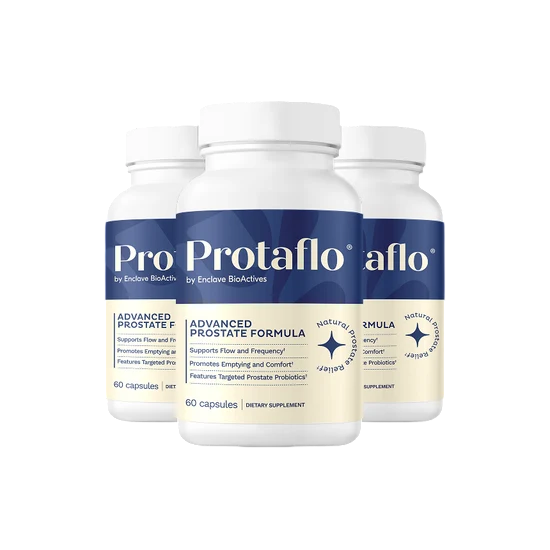
Complete the Picture — Add Protaflo® to Your Active Lifestyle
Exercise builds the foundation. Protaflo's botanical formula supports the hormonal and cellular environment for comprehensive daily prostate wellness. Just two capsules with breakfast.
Get Protaflo — Limited Time Discount*These statements have not been evaluated by the FDA. Not intended to diagnose, treat, cure, or prevent any disease.